

Introduction
The bench press is one of the most popular and effective strength-training exercises in the world. Whether you are a beginner starting your fitness journey or an experienced athlete looking to build more upper-body strength, the bench press deserves a place in your workout routine.
This compound exercise targets multiple muscle groups at the same time, making it highly efficient for increasing muscle mass, improving strength, and boosting athletic performance. It is commonly performed with a barbell, but dumbbells and machines can also be used depending on your fitness level and goals.
Many people think the bench press is only for bodybuilders or powerlifters, but that is not true. When performed with proper technique, it is suitable for anyone who wants to improve their fitness, strengthen their chest, and build a balanced upper body.
In this guide, you will learn everything you need to know about the bench press, including the muscles it works, different variations, health benefits, physical advantages, and tips for getting the best results safely.
What Is Bench Press Exercise?
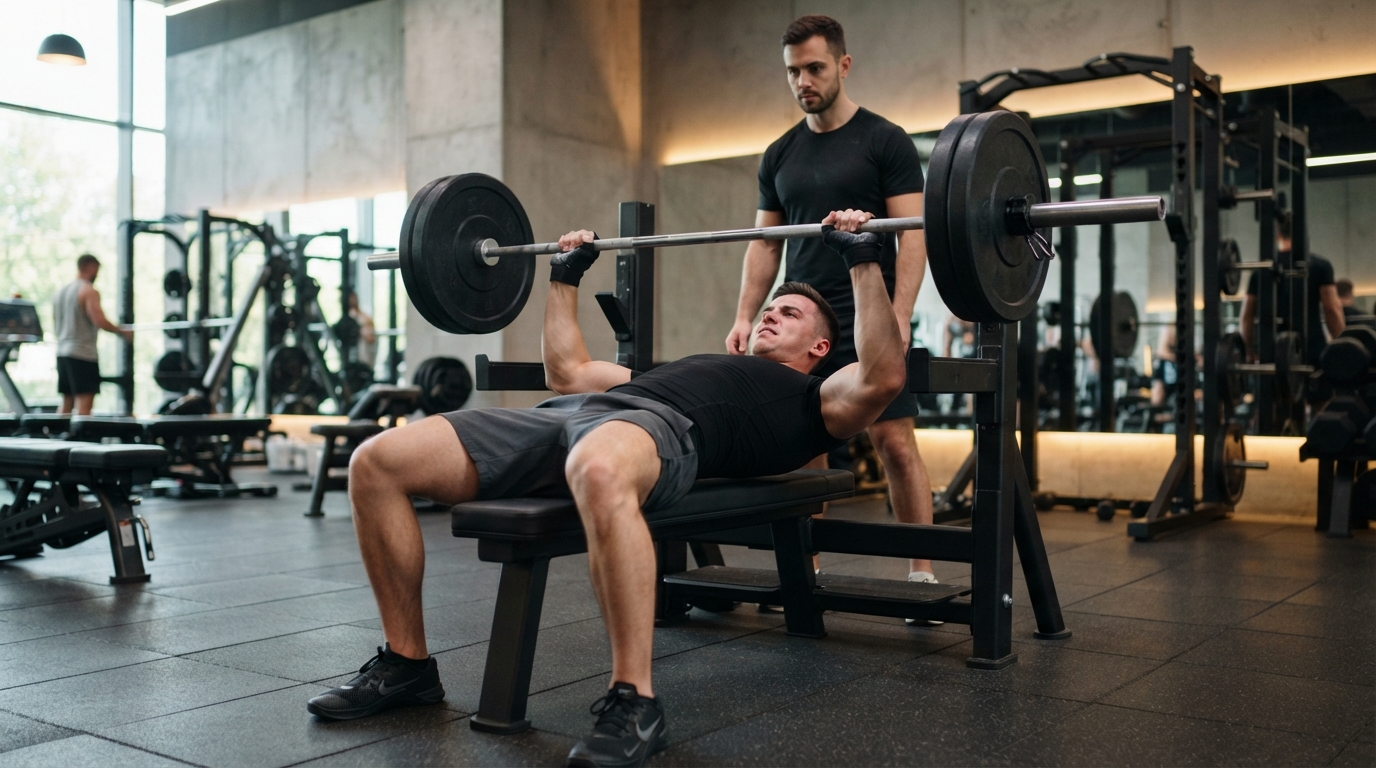
The bench press is a compound strength-training exercise performed while lying on a flat, incline, or decline bench. During the exercise, you press a barbell or dumbbells upward from your chest until your arms are fully extended, then slowly lower the weight back to the starting position.
Unlike isolation exercises that focus on a single muscle, the bench press works several major muscle groups together. This makes it one of the most effective exercises for building upper-body strength and muscle.
The bench press is commonly included in:
- Strength training programs
- Bodybuilding routines
- Athletic conditioning
- Powerlifting competitions
- General fitness workouts
Because it allows progressive overload—gradually increasing the weight over time—it is an excellent exercise for improving strength and muscle growth.
Muscles Worked During the Bench Press
One of the biggest advantages of the bench press is that it targets multiple muscles in a single movement.
Primary Muscles
Chest (Pectoralis Major)
The chest muscles perform most of the work during the press. They help push the weight upward and are responsible for building a broader and stronger chest.
Triceps
The triceps, located on the back of your upper arms, straighten your elbows as you press the weight upward. Strong triceps improve your pressing power and overall upper-body strength.
Front Shoulders (Anterior Deltoids)
The front part of the shoulders helps stabilize and move the weight throughout the exercise.
Secondary Muscles
Several supporting muscles also become active during the bench press, including:
- Upper back muscles
- Shoulder stabilizers
- Forearms
- Core muscles
- Lats (Latissimus dorsi)
Keeping these muscles engaged improves stability and control while lifting.
1. Flat Barbell Bench Press
The flat barbell bench press is the classic version of the exercise and is commonly used for building overall chest strength and muscle.
Benefits
- Builds overall chest size
- Increases upper-body strength
- Allows heavier lifting
- Ideal for progressive overload
2. Incline Bench Press
The incline bench press is performed on a bench set at an angle of about 30–45 degrees.
Benefits
- Targets the upper chest
- Improves shoulder strength
- Creates a fuller chest appearance
- Enhances overall upper-body balance
3. Decline Bench Press
The decline bench press places the body at a slight downward angle.
Benefits
- Emphasizes the lower chest
- Reduces shoulder stress for some lifters
- Allows strong pressing movement
4. Dumbbell Bench Press
Instead of using a barbell, this variation uses two dumbbells.
Benefits
- Improves muscle balance
- Increases range of motion
- Strengthens stabilizer muscles
- Helps correct strength differences between arms
5. Close-Grip Bench Press
The hands are placed closer together on the bar.
Benefits
- Targets the triceps
- Improves lockout strength
- Builds stronger arms
- Supports other pressing exercises
6. Smith Machine Bench Press
This variation uses a guided machine that controls the movement of the bar.
Benefits
- Good for beginners
- Improves confidence
- Provides extra stability
- Useful when training alone
Health Benefits of Bench Press Exercise
The bench press offers more than just bigger muscles. It contributes to better overall health and physical performance.
Increases Functional Strength
Everyday activities such as pushing heavy doors, lifting boxes, carrying groceries, or moving furniture become easier when your upper-body strength improves.
Supports Healthy Bones
Resistance training places healthy stress on your bones, encouraging them to become stronger over time. This may help reduce the risk of age-related bone loss.
Improves Metabolism
Building lean muscle increases your resting metabolic rate, meaning your body burns more calories throughout the day—even while resting.
Enhances Athletic Performance
Athletes in sports such as football, basketball, rugby, swimming, and martial arts often include the bench press in their training because it develops explosive upper-body power.
Improves Joint Stability
When performed correctly, the bench press strengthens the muscles around the shoulders and elbows, helping improve joint stability and reduce the risk of certain injuries.
Encourages Better Fitness Habits
Learning proper bench press technique often motivates people to maintain a consistent workout routine, leading to improved overall health and fitness
Physical Benefits of Bench Press Exercise
Regular bench press training can produce noticeable improvements in your physique and strength.
Builds a Stronger Chest
The bench press is one of the best exercises for developing the chest muscles. A stronger chest improves both appearance and functional strength.
Increases Upper-Body Strength
The exercise strengthens the chest, shoulders, and triceps simultaneously, making it easier to perform many other exercises and daily tasks.
Promotes Muscle Growth
Using progressive overload—gradually increasing weight or repetitions—stimulates muscle growth over time. Combined with proper nutrition and recovery, the bench press is highly effective for building muscle.
Improves Muscle Symmetry
Variations such as the dumbbell bench press help correct strength imbalances between the left and right sides of the body, leading to better muscle symmetry and coordination.
Boosts Confidence
As your strength improves and you achieve new personal records, your confidence often grows both inside and outside the gym. Reaching fitness goals can provide a strong sense of accomplishment and motivation to continue training.
Supports Better Posture
When combined with exercises that strengthen the back and core, the bench press contributes to a more balanced upper body and improved posture.
Proper Bench Press Technique
Using the correct bench press technique is essential for building strength safely and reducing the risk of injury. Good form allows you to lift more efficiently while protecting your shoulders, elbows, and wrists.
1. Position Yourself Correctly
Lie flat on the bench with your eyes directly under the barbell. Keep your feet flat on the floor and maintain a stable base throughout the movement.
2. Grip the Bar
Hold the bar slightly wider than shoulder-width apart. Wrap your thumbs around the bar for a secure grip, and keep your wrists straight to avoid unnecessary strain.
3. Retract Your Shoulder Blades
Pull your shoulder blades together and press them into the bench. This creates a stable foundation and helps protect your shoulders.
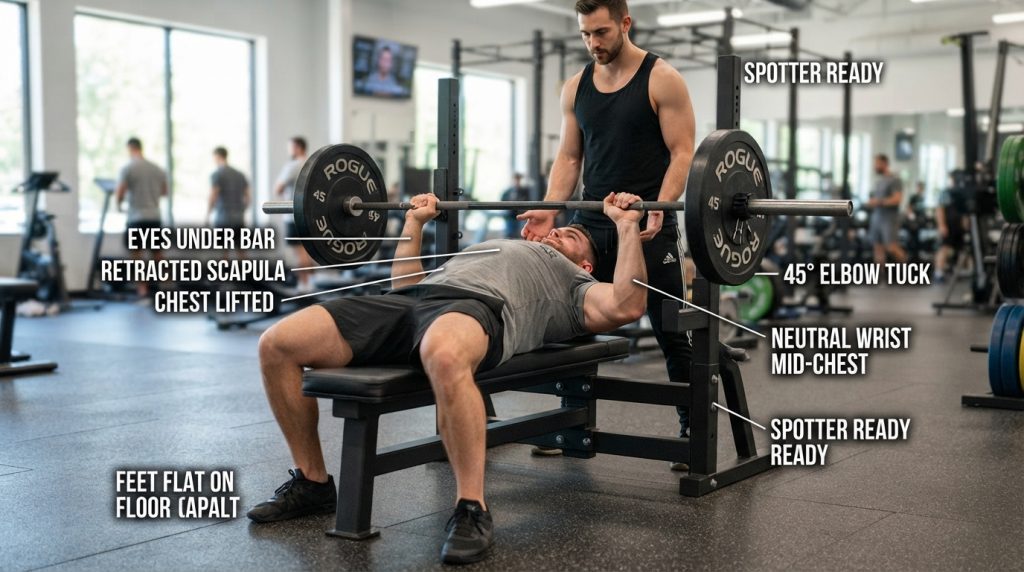
4. Lower the Bar Slowly
Unrack the bar and lower it under control to the middle of your chest. Keep your elbows at about a 45-degree angle from your body rather than flaring them out.
5. Press the Bar Up
Push the bar upward until your arms are fully extended without locking your elbows aggressively. Exhale as you press and maintain control throughout the movement.
6. Repeat with Control
Avoid bouncing the bar off your chest or using momentum. Perform each repetition smoothly and consistently.
Step-by-Step Bench Press Guide
Follow these steps every time you bench press:
- Warm up with light cardio and shoulder mobility exercises.
- Load an appropriate weight based on your experience.
- Lie on the bench with proper body alignment.
- Grip the bar evenly.
- Unrack the bar with straight arms.
- Lower the bar slowly to your chest.
- Pause briefly without bouncing.
- Press the bar upward in a controlled motion.
- Complete your planned repetitions.
- Carefully return the bar to the rack.
For beginners, start with a weight you can lift comfortably for 8–12 repetitions while maintaining perfect form.
Beginner Bench Press Plan
A simple beginner routine helps build strength gradually while reducing the risk of injury.
Week 1
- 2 sessions
- 3 sets × 10 reps
- Light weight
- Focus on technique
Week 2
- 2–3 sessions
- 3 sets × 10 reps
- Slightly increase the weight if your form remains solid.
Week 3
- 3 sessions
- 4 sets × 8–10 reps
- Continue practicing controlled movements.
Week 4
- 3 sessions
- 4 sets × 6–8 reps
- Increase the weight gradually while maintaining proper technique.
Rest: Take 60–90 seconds between sets.
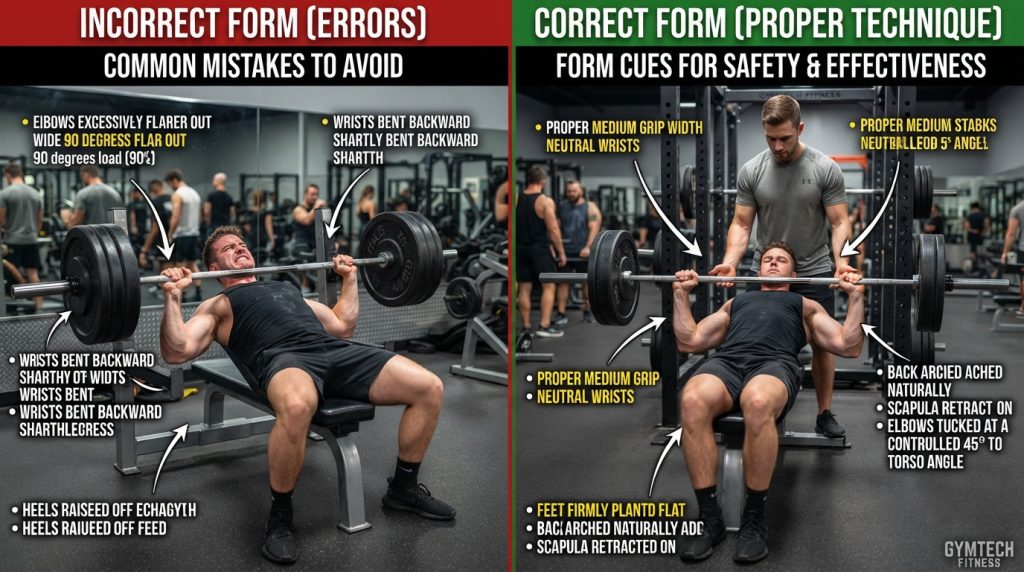
Common Bench Press Mistakes
Avoid these common mistakes to improve your performance and stay safe.
Lifting Too Much Weight
Many beginners try to lift heavy weights too soon. This often leads to poor technique and increases the risk of injury.
Bouncing the Bar
Allowing the bar to bounce off your chest reduces muscle activation and can cause serious injuries.
Incorrect Grip Width
A grip that is too wide or too narrow places unnecessary stress on your shoulders and wrists.
Lifting Your Feet
Keep your feet firmly planted on the floor throughout the exercise for better balance and stability.
Poor Breathing
Holding your breath for too long can reduce performance. Inhale while lowering the bar and exhale as you press it upward.
Ignoring Warm-Up
Skipping your warm-up increases the risk of muscle strains and shoulder injuries.
Safety Tips
Safety should always come first during any strength-training exercise.
- Always warm up before lifting.
- Use a spotter when lifting heavy weights.
- Choose a weight you can control.
- Keep your wrists straight.
- Maintain proper posture throughout the exercise.
- Never sacrifice technique for heavier weights.
- Stop immediately if you experience sharp pain.
- Allow enough rest between training sessions.
- Inspect equipment before each workout.
- Stay hydrated during your workout.
Bench Press for Muscle Growth
The bench press is one of the most effective exercises for building muscle because it allows progressive overload.
For muscle growth:
- Perform 3–5 sets of 8–12 repetitions.
- Increase the weight gradually over time.
- Train your chest 1–2 times per week.
- Eat enough protein to support muscle recovery.
- Get 7–9 hours of quality sleep each night.
Consistency is more important than lifting extremely heavy weights. Good form combined with gradual progress leads to the best long-term results.
Bench Press for Strength
If your goal is to improve maximum strength rather than muscle size:
- Perform 3–6 sets of 3–6 repetitions.
- Use heavier weights with proper form.
- Rest 2–4 minutes between sets.
- Focus on controlled, powerful movements.
- Include other compound exercises such as squats, deadlifts, and overhead presses for balanced strength development.
Bench Press vs. Push-Ups
| Bench Press | Push-Ups |
|---|---|
| Requires gym equipment | Uses body weight only |
| Easy to increase resistance | Resistance depends on body weight |
| Builds maximum strength | Improves muscular endurance |
| Better for progressive overload | Ideal for home workouts |
| Targets chest, shoulders, and triceps | Targets similar muscles while also engaging the core |
Both exercises are excellent. Beginners can start with push-ups to build a foundation before progressing to the bench press. Combining both exercises can provide balanced upper-body development.
What Equipment Do You Need?
You don’t need a large commercial gym to perform the bench press. The following equipment is recommended:
- Flat or adjustable weight bench
- Olympic or standard barbell
- Weight plates
- Dumbbells (optional)
- Power rack or squat rack
- Safety bars
- Weight collars
- Spotter (recommended for heavy lifts)
- Comfortable workout clothing
- Flat-soled training shoes
Frequently Asked Questions (FAQs)
1. Is the bench press suitable for beginners?
Yes. Beginners should start with light weights, focus on learning proper form, and increase the weight gradually as they become stronger.
2. How many times should I bench press each week?
Most people benefit from bench pressing 1–2 times per week, allowing enough time for muscles to recover between sessions.
3. Which muscles does the bench press work?
The bench press mainly targets the chest (pectorals), triceps, and front shoulders, while also engaging the upper back and core for stability.
4. Should I use a spotter?
A spotter is strongly recommended whenever lifting heavy weights or attempting a new personal best. They can assist if you struggle to complete a repetition safely.
5. Can the bench press help with weight loss?
Yes. While the bench press itself is not a high-calorie-burning exercise, it builds lean muscle, which increases your resting metabolism. Combined with a healthy diet and regular cardio, it can support long-term weight management.
Conclusion
The bench press is one of the most effective compound exercises for building upper-body strength, increasing muscle mass, and improving overall fitness. It targets the chest, shoulders, and triceps while also strengthening supporting muscles that enhance stability and performance.
Success with the bench press comes from mastering proper technique, progressing gradually, and staying consistent with your training. Beginners should prioritize good form over heavy weights, while experienced lifters can continue to challenge themselves through progressive overload and structured training plans.
Remember that recovery, nutrition, and adequate sleep are just as important as your workouts. By combining smart training with healthy lifestyle habits, the bench press can become a key exercise for achieving your strength and fitness goals.
Whether you train at home or in the gym, adding the bench press to your routine is an excellent investment in your long-term health, strength, and confidence.